How to Spot a Fake TikTok Engagement Rate Before You Buy
Quick answer: A strong engagement percentage isn't proof of genuine engagement on its own — here's how sellers manufacture the appearance of real engagement, and how.
Our buying guides stress engagement rate over follower count again and again. Sadly, that makes engagement rate a target for manipulation. Buyers now check engagement rate, not just follower count. So a seller has a reason to fake the look of real engagement. This guide shows exactly how to tell the difference.
Method 1: Engagement Pods and Reciprocal Liking Groups
Engagement pods are private groups. Members agree to like, comment, and share each other's content right after it is posted. This inflates early engagement signals. As a side effect, it can trigger real algorithmic distribution. The engagement is real and human-made, so it is harder to spot than bot activity. But it does not show a truly natural, interested audience.
How to spot it: Pod-driven engagement often follows a clear pattern. Look for a cluster of very fast comments and likes in the first few minutes of a post. Look for generic comments that could fit any video and do not mention the specific video. Look for the same set of accounts on different, unrelated videos from the same channel.
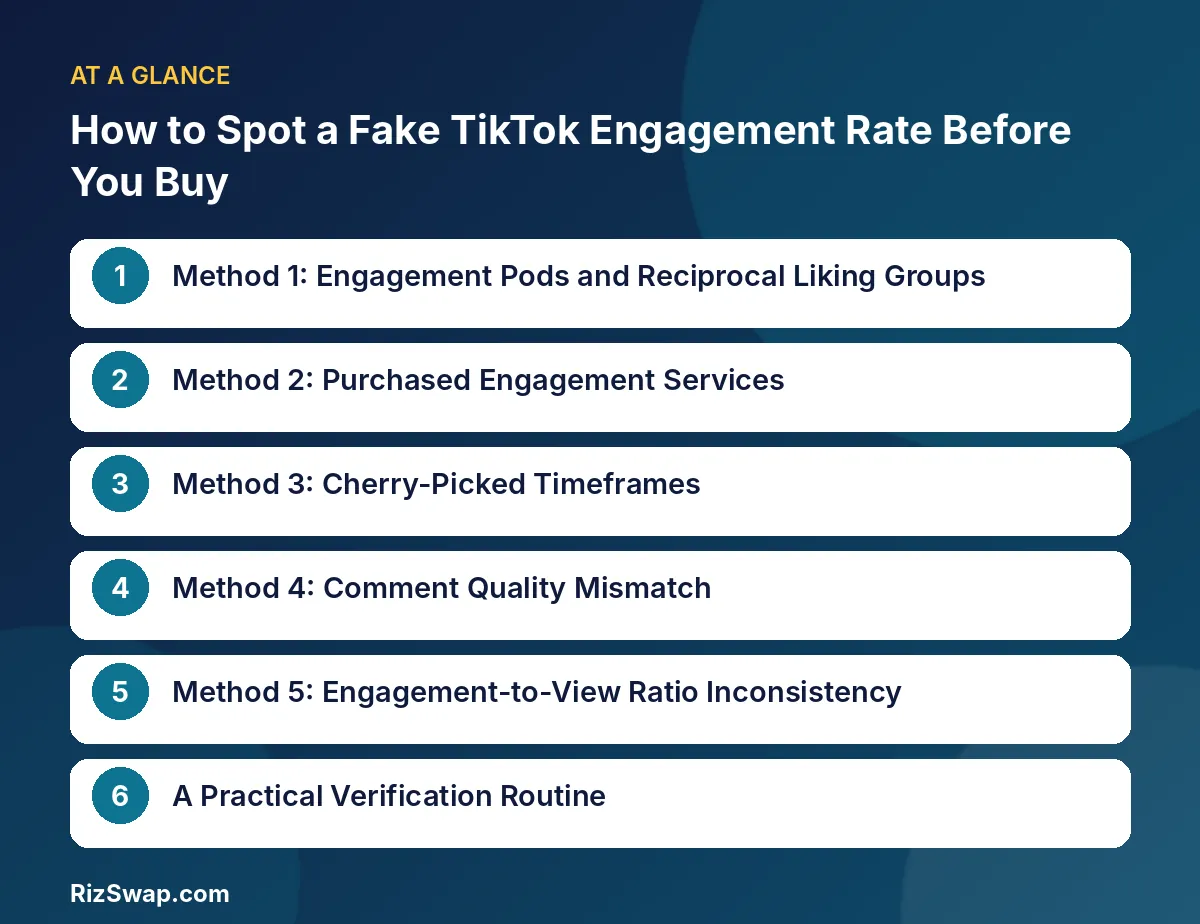
Method 2: Purchased Engagement Services
Many services sell packages of likes, comments, and even views. Some use obvious fake bot accounts. Others are more advanced and use real accounts with no interest in the content. These are sometimes based overseas and engage only for pay.
How to spot it: Check the profiles of the accounts that engage with the content. Bot or low-quality purchased accounts often have few or no posts of their own. They often use generic or stock-photo-style profile pictures. Their follower/following ratios often look odd. A common bot pattern is following thousands of accounts with very few followers.
Method 3: Cherry-Picked Timeframes
A seller might show engagement data from a short window. That window may include one oddly strong video. It then fails to show a fair average of the account's typical performance.
How to spot it: Always ask for engagement data over a longer window. Ask for at least the last 15-20 posts, ideally spanning several months. Do not accept a summary statistic alone. Ask to see the video-by-video breakdown behind it.
Method 4: Comment Quality Mismatch
Some videos have a strong comment count, but the comments do not relate to the content. They may be generic praise, strings of random emoji, or comments that could fit literally any video. This is a signal of faked engagement, not natural engagement.
How to spot it: Read the actual comments. Do not just note the count. Real engagement includes specific reactions, questions, disagreements, and references to details in the content. It is messy and varied. It is clearly tied to what is in the video.
Method 5: Engagement-to-View Ratio Inconsistency
Real engagement usually grows in rough proportion to view count across an account's content. Compare each video's likes and comments to its own views. Say one video has an oddly high ratio next to the account's typical ratio. That can mean engagement was added artificially, apart from real viewership.
How to spot it: Compare the engagement-to-view ratio across several videos from the same account. Real accounts show fairly steady ratios. Accounts with inflated engagement on certain videos show odd spikes that do not match view count.
A Practical Verification Routine
- Review at least 15-20 recent posts, not a cherry-picked few
- Read a real sample of comments on several videos. Look for specific, varied, content-relevant responses
- Spot-check 10-15 accounts that engage with content. Check profile completeness, posting history, and follower/following ratio
- Compare engagement-to-view ratios across multiple videos for consistency
- Ask for live access to TikTok's own Creator Tools analytics. It shows audience data that is harder to fake than surface-level engagement numbers alone
Why This Matters More Than Follower Count Verification
As our buying guides explain, engagement rate is now the main metric serious buyers use to judge real account value. That also makes it the main target for faked appearances. These fakes are built to satisfy exactly this kind of buyer check. Do not treat a strong engagement percentage as by default trustworthy. Skipping the deeper checks above defeats the purpose of looking past follower count in the first place.
What to Do If You Suspect Manufactured Engagement
Verification may reveal signs of pod activity, purchased engagement, or cherry-picked data. This does not always mean you must walk away. You can lower your price expectation by a large amount. Value the account closer to its follower-count-only value.
Do not pay the inflated value the fake engagement was built to suggest. Or you can decline the purchase if the gap between claimed and verified value is too large to bridge through negotiation.
A Note on False Positives
Some real accounts show one or two of these warning signs without any real manipulation. A viral moment, for instance, can briefly produce odd engagement patterns. Treat these signals as reasons to dig deeper. Do not treat them as automatic disqualification. Weigh the overall pattern across multiple checks. Do not react to any single signal alone.
Ready to see what's currently available? Browse TikTok account listings on RizSwap, all protected by escrow from listing to handover.
Final Thoughts
A healthy engagement percentage is necessary, but it is not enough to show real account value. Sellers know buyers check this metric. They have a real reason to fake it through pods, purchased engagement, or selectively shown data.
The techniques covered here are reviewing comment quality, checking engager profiles, and comparing ratios across multiple posts. They separate real engagement from fake imitations far more reliably than the headline engagement percentage alone.