How to Take Screenshots That Actually Prove Your Account's Stats When Selling
Quick answer: A screenshot alone doesn't prove much anymore — buyers know they can be edited.
Our buyer guides cover this at length. Experienced buyers doubt static screenshots. Anyone with basic software skills can edit a number in an image. This puts honest sellers in an awkward spot. Real proof and fake proof can look the same in a simple screenshot. This guide shows how sellers can capture and present proof that builds buyer trust. It avoids the doubt a fake listing would bring.
Why Basic Screenshots Fail to Build Trust Anymore
Picture a cropped, zoomed-in image of just a revenue number or follower count. It has no context around it. A fake screenshot would look exactly the same. Buyers who read guides like our engagement verification guide are trained to distrust this kind of proof. So sellers who rely on it only face needless doubt. This happens even when their numbers are fully genuine.
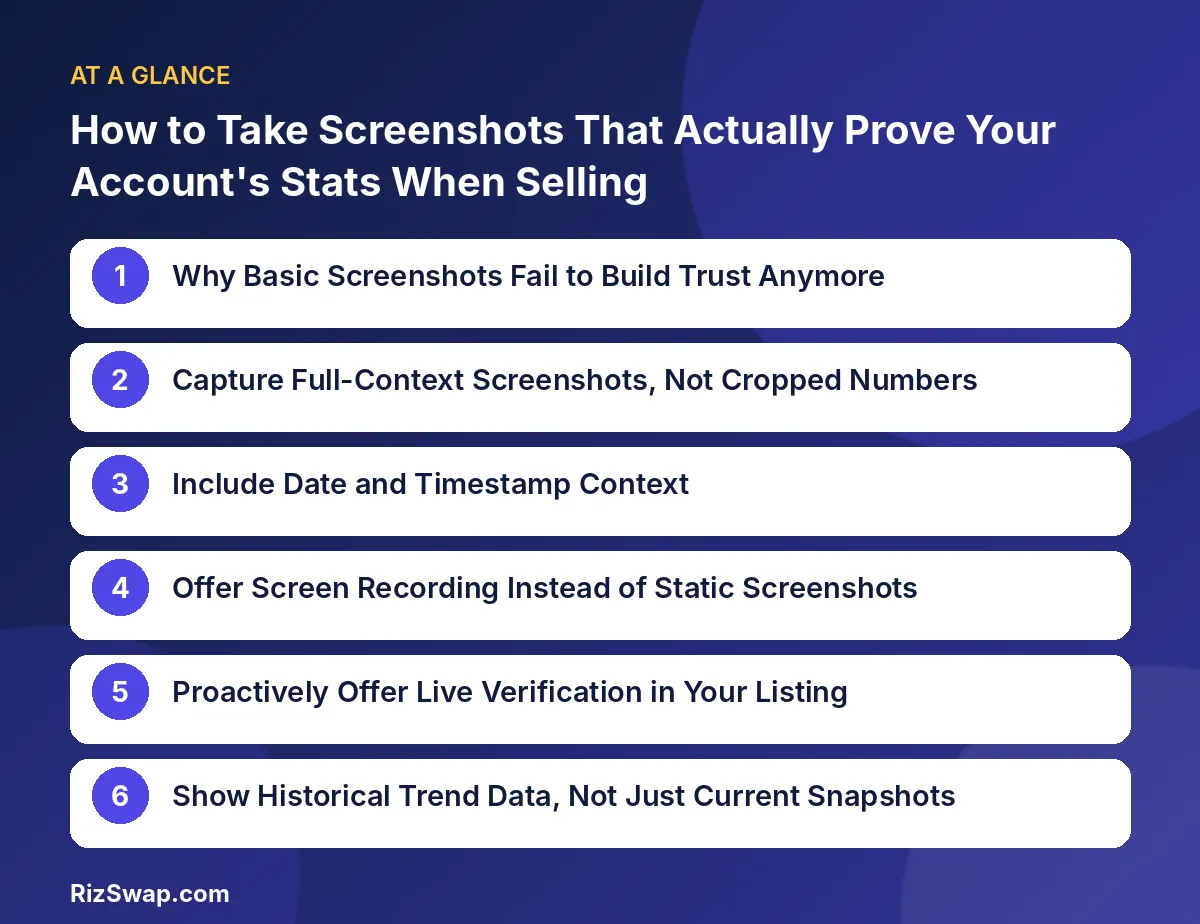
Capture Full-Context Screenshots, Not Cropped Numbers
Do not crop tightly around a single number. Capture the full analytics dashboard view. Include the platform's own interface, the date range selectors, and the data around them. It is hard to fake a complete, coherent scene like this. A full YouTube Studio Analytics view of the entire dashboard is far more credible. An isolated number pasted onto an unrelated background is not.
Include Date and Timestamp Context
Make sure screenshots clearly show the date range on display. Where practical, also include your device's system clock or notification bar in the frame. This extra context makes it much harder to pass off old or cherry-picked data as current. It also shows a careful buyer that you are open.
Offer Screen Recording Instead of Static Screenshots
A short screen recording is more credible than any static image. In it, you click through your platform's Analytics or Studio interface in real time. It shows live, current access, which a screenshot cannot do. It does not need to be fancy. A simple phone screen capture of you clicking through key sections takes only a few minutes. It greatly strengthens your listing's credibility.
Proactively Offer Live Verification in Your Listing
Do not wait for a buyer to ask. State in your listing that you will give live, supervised verification by video call before you finalize a sale. This follows the approach recommended throughout our buying guides. This one statement often answers much of a buyer's doubt before it starts. It shows you have nothing to hide and expect to be asked for proof.
Show Historical Trend Data, Not Just Current Snapshots
A single point-in-time screenshot shows one number. A trend chart over several months shows a pattern. That pattern is much harder to fake. It also tells a genuine buyer more about the account's path, not just its current state. This speaks directly to the growth-trend evaluation covered in our channel pricing guide.
Avoid Over-Editing or Annotating Screenshots
It is fine to blur or redact truly sensitive information, such as your personal email address on a settings screen. But avoid heavy annotation, cropping, or editing beyond what privacy needs. Too much editing can look like the manipulation buyers watch for. This is true even when your intentions are fully honest.
Build a Consistent Documentation Habit Before You List
Do not scramble for proof only when you decide to sell. Make it a habit to take periodic screenshots or brief recordings of your account's key metrics. This gives you a genuine historical record to use when you list. It is far more convincing than proof gathered all at once just before a sale. It shows the account's performance was documented as it happened, not rebuilt after the fact.
What This Signals to Serious Buyers
A legitimate seller with nothing to hide would naturally do all of this. They give full-context screenshots and offer screen recordings. They suggest live verification up front. They show trend data, not isolated snapshots. This pattern of thorough, proactive documentation is itself a trust signal, apart from the numbers shown. It tends to attract more serious offers with less negotiation friction.
A Small Investment That Pays Off Repeatedly
The extra fifteen minutes spent on full-context screenshots or a brief recording is not a one-time cost. The same documentation can support many buyer conversations if your first offer does not close. Once the habit is part of your routine for managing your account, it gets easier over time.
Final Thoughts
Buyers have learned to distrust isolated, cropped screenshots. Sellers who put in a little extra effort stand out right away. They offer full-context documentation, screen recordings, and proactive verification. Listings that rely on easily faked static images do not stand out. This small extra effort consistently brings faster sales, less negotiation friction, and stronger buyer trust from the very first message.