How to Verify a Seller's Identity Before Buying a Social Media Account
Quick answer: Confirming an account is genuine tells you nothing about whether the person selling it is the legitimate owner with the right to sell it.
Every guide in this series has covered how to verify that an account is real. That means real engagement, accurate stats, and working access. A second question gets less attention but matters just as much. Is the person you are dealing with the real owner, with the right to sell the account?
A stolen or compromised account can pass every technical check in our guides. Yet the seller may have no right to sell it.
Why Account Verification and Seller Verification Are Different Checks
Live access verification proves someone can log into an account now. It shows present control. It does not show who really owned the account. A hacker who took over an account can show the same live access a real owner could. The technical steps in our platform guides do not, on their own, tell these two cases apart.
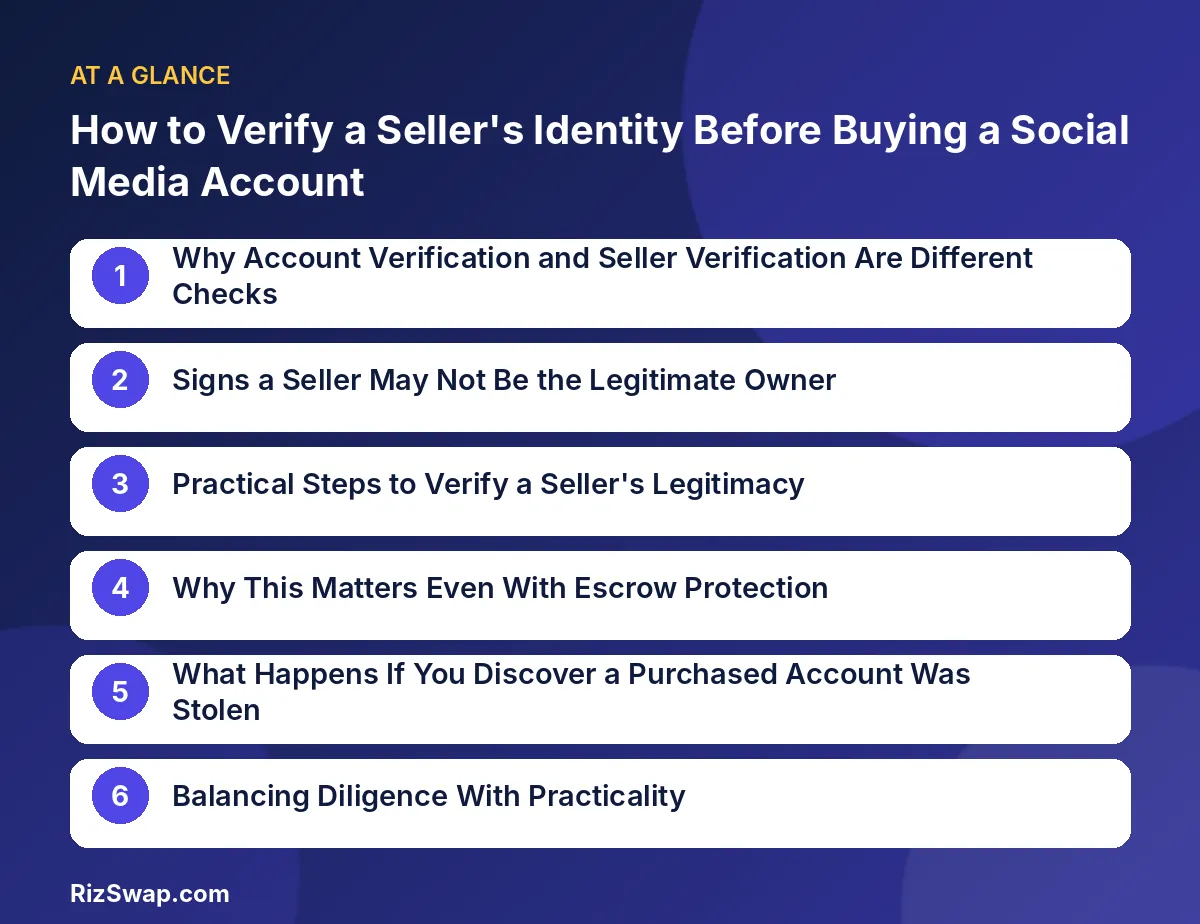
Signs a Seller May Not Be the Legitimate Owner
Inconsistent Knowledge of Account History
A real long-term owner usually knows the account's history in detail. They know why they made certain content choices. They know what challenges they faced while growing it. Someone who just took over the account would struggle to fake these details. Vague or inconsistent answers to detailed history questions are worth noting.
Urgency to Sell Quickly at a Below-Market Price
This sign is not proof on its own. Real sellers sometimes need to sell fast for real personal reasons. But odd urgency plus a price far below what the account's real metrics justify deserves extra checks. Compromised accounts are often sold fast and cheap. The thief wants to sell before the real owner notices and reports the theft.
Recently Changed Account Recovery Information
On some platforms, account activity logs show when the seller's own access began. Suppose that access is very recent. This can mean the account changed hands shortly before it was listed. The change may have been ilreal.
Reluctance to Use Platform-Verified Communication or Payment Systems
Some sellers push to move chat and payment off-platform. They avoid any system that leaves a record or needs identity-adjacent verification. Treat this pattern with caution. It fits the broader scam-avoidance principles in our dedicated guide.
Practical Steps to Verify a Seller's Legitimacy
Ask Detailed, Specific Questions About Account History
Skip generic questions. Ask about details only a real long-term owner would know. Examples are audience feedback patterns, specific content choices and why they were made, and challenges at certain growth stages. Detailed, consistent, confident answers are a good sign. Vague or evasive answers are not.
Check Seller Reputation on the Marketplace Itself
A seller with a history of completed transactions and positive reviews on RizSwap carries much more trust. A seller with no transaction history carries less. Platform reputation is built over many successful, verified transactions. It is a real signal of legitimacy, and it is hard to fake quickly.
Request a Longer Verification Window for Larger Purchases
For higher-value accounts, take more time for a thorough live verification session. Include detailed history questions along with the standard technical checks. This is reasonable. Do not rush it, whatever urgency the seller shows.
Why This Matters Even With Escrow Protection
Be clear on what escrow does. Escrow protects the payment sequence. Funds are not released until the buyer confirms working access. But escrow does not check on its own that the seller has the right to own the account. Say a compromised account is sold through escrow.
The original owner later reports the theft to the platform. The buyer can still lose access, even after a technically "successful" escrow transaction. The platform (YouTube, Instagram, etc.) will generally restore access to the verified original owner. A private resale does not change that.
What Happens If You Discover a Purchased Account Was Stolen
Evidence may emerge after purchase that the seller obtained the account ilreally. This is the kind of case RizSwap's dispute resolution process is built for. It is covered in our dedicated guide on that topic. It gives you a path to recover funds even after a deal that first looked complete. You must report the case, and proof must be available.
Balancing Diligence With Practicality
Not every deal needs a deep look into the seller's history. For smaller, lower-value purchases from sellers with a good platform reputation, the standard account verification in our other guides is usually enough. Deeper seller-legitimacy checks matter more as the value rises. They also matter more when other risk signals appear. These signals include urgency, odd pricing, and reluctance to answer detailed questions.
Trusting Your Own Judgment
Beyond any checklist, buyers often develop a fairly accurate gut sense after several real talks with a seller. They can tell if the person seems knowledgeable and consistent, or evasive and rehearsed. This instinct comes from the verification conversations covered above. Weigh it alongside the more concrete checks. Do not dismiss it as unreliable.
Final Thoughts
Checking that an account is technically real is one thing. Checking that the seller has a real right to sell it is another. They are two distinct checks. Buyers who only do the first stay exposed to the risk of buying a compromised or stolen account.
Ask detailed history questions. Check the seller's platform reputation. Apply extra checks when urgency and odd pricing appear together. These steps greatly reduce this less-discussed but important risk in the social media account marketplace.