Buying vs Building a Social Media Account From Scratch: The Real Cost Comparison
Quick answer: Building from scratch looks free on paper, but the real cost — measured in time, uncertainty, and opportunity cost — often outweighs the purchase.

People often compare building a social media presence with buying one by looking only at the price tag. Buying costs money upfront. Building "just" costs time. This view misses most of the real costs. A fair comparison must count your time.
It must count the real risk that organic growth fails. It must also count the opportunity cost of the months or years an account earns nothing while you build it.
The True Cost of Building From Scratch
Time Investment
YouTube sets monetization thresholds of 1,000 subscribers and 4,000 watch hours. Most creators need six months to two years of steady uploads to reach them. The time depends on niche, content quality, and a fair bit of luck with the algorithm.
Put even a modest hourly rate on research, filming, and editing time. The result is a large real cost. It never appears on an invoice, but it is still real.
The Genuine Risk of Failure
A meaningful share of new channels and accounts never reach monetization thresholds. This happens no matter how much effort they put in. Algorithmic distribution is unpredictable. Good content alone does not guarantee an audience. The "building is free" view hides this risk.
Yet it is one of the most important factors in a fair comparison. When you buy an established, already-monetized account, you remove this failure risk entirely. The account has already proven the format works.
Opportunity Cost
Every month an account spends unmonetized is a month of lost revenue. An established account would be earning that money instead. Some buyers have a specific revenue goal or timeline, such as launching a product or building an income stream by a set date. For them, this opportunity cost can be the largest hidden expense of building from scratch.
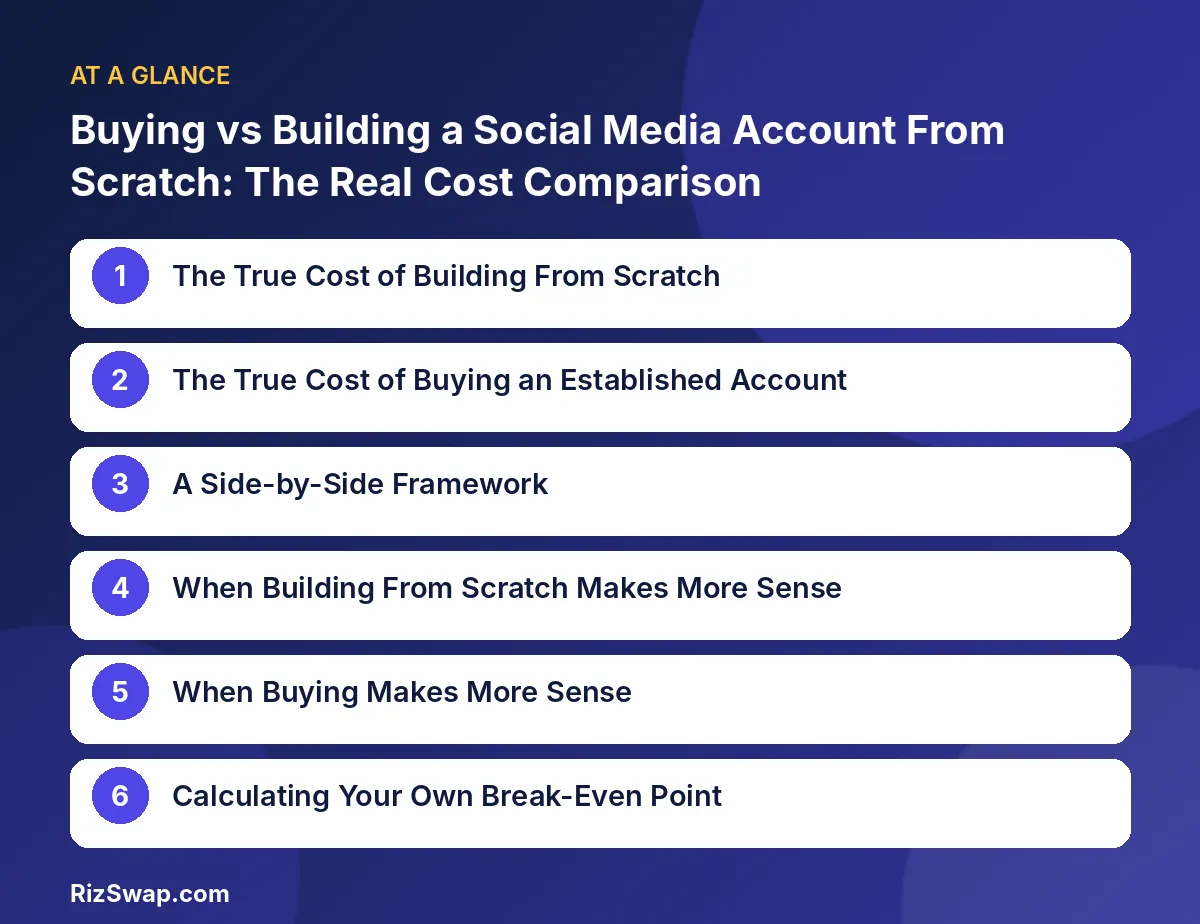
The True Cost of Buying an Established Account
Upfront Purchase Price
This is the visible, easy-to-compare cost. It is usually a multiple of proven monthly revenue, as covered in our channel pricing guide. This means the purchase pays for itself over a set, calculable period based on the account's existing earnings.
Transaction Risk (If Not Properly Managed)
Buying has its own type of risk: verification and transaction safety. We cover it in our scam-avoidance guide and in platform-specific verification guides. Organic growth can fail despite real effort, and you cannot fix that. This risk is different. You can largely address it with proper verification and escrow protection. That makes it easier to control than the uncertainty of organic growth.
Continuity Effort
After you buy, you still need to keep up the account's content quality and consistency. This protects its value. This ongoing effort exists on both paths. But when you buy, you start with an established audience and algorithmic trust, not from zero.
A Side-by-Side Framework
| Factor | Building From Scratch | Buying Established |
|---|---|---|
| Time to revenue | 6 months - 2+ years, uncertain | Immediate, upon transfer |
| Failure risk | Real and significant | Low, if properly verified |
| Upfront cost | Low/none (excluding time value) | Purchase price, calculable ROI |
| Ongoing effort required | High, from zero | Moderate, maintaining momentum |
When Building From Scratch Makes More Sense
Building is the better path when your content is deeply personal. It should be tied to your own expertise or story. In these categories, buying an existing account gives little real advantage. The audience's core value is a personal connection, and that cannot be transferred. Building also makes sense if you have unlimited time. It suits you if you have no urgency to reach revenue milestones by a set date.
When Buying Makes More Sense
Buying is the stronger option in several cases. One is faceless or format-driven content, covered in our faceless channel guide. Another is a buyer with a specific revenue timeline. Another is a business that needs an established presence for a product launch. It also fits anyone who has weighed the real time and failure-risk cost of building. If the purchase price is then comparable or lower, buying wins.
Calculating Your Own Break-Even Point
Try this exercise. Estimate how many hours it would take to build a comparable account from scratch. Multiply by what your time is truly worth. Then add a risk adjustment for the real chance of failure despite that effort. Compare the total to the price of an established, verified account with similar current performance.
Most buyers who do this honestly find the gap is far smaller than expected. Often it favors buying. The simple "building is free" view suggests otherwise.
A Hybrid Approach Worth Considering
Some of the best outcomes combine both paths. First, buy an established account in a stable, format-driven niche as a foundation. Then build new content, or even a second account, alongside it. Use the established account's revenue and audience insight to fund and guide the new effort.
This reduces reliance on any single approach. It spreads the opportunity and the risk across two complementary strategies. You do not bet everything on one path.
Final Thoughts
Building a social media account from scratch is never truly free. It carries large hidden costs in time, failure risk, and lost revenue. People rarely weigh these against the visible price tag of buying an established account. A fair comparison counts all of these factors, not just the upfront number.
It often favors buying. This is true for anyone with format-driven content plans or a defined revenue timeline. It is also true for anyone who knows how much effort and uncertainty organic growth involves.